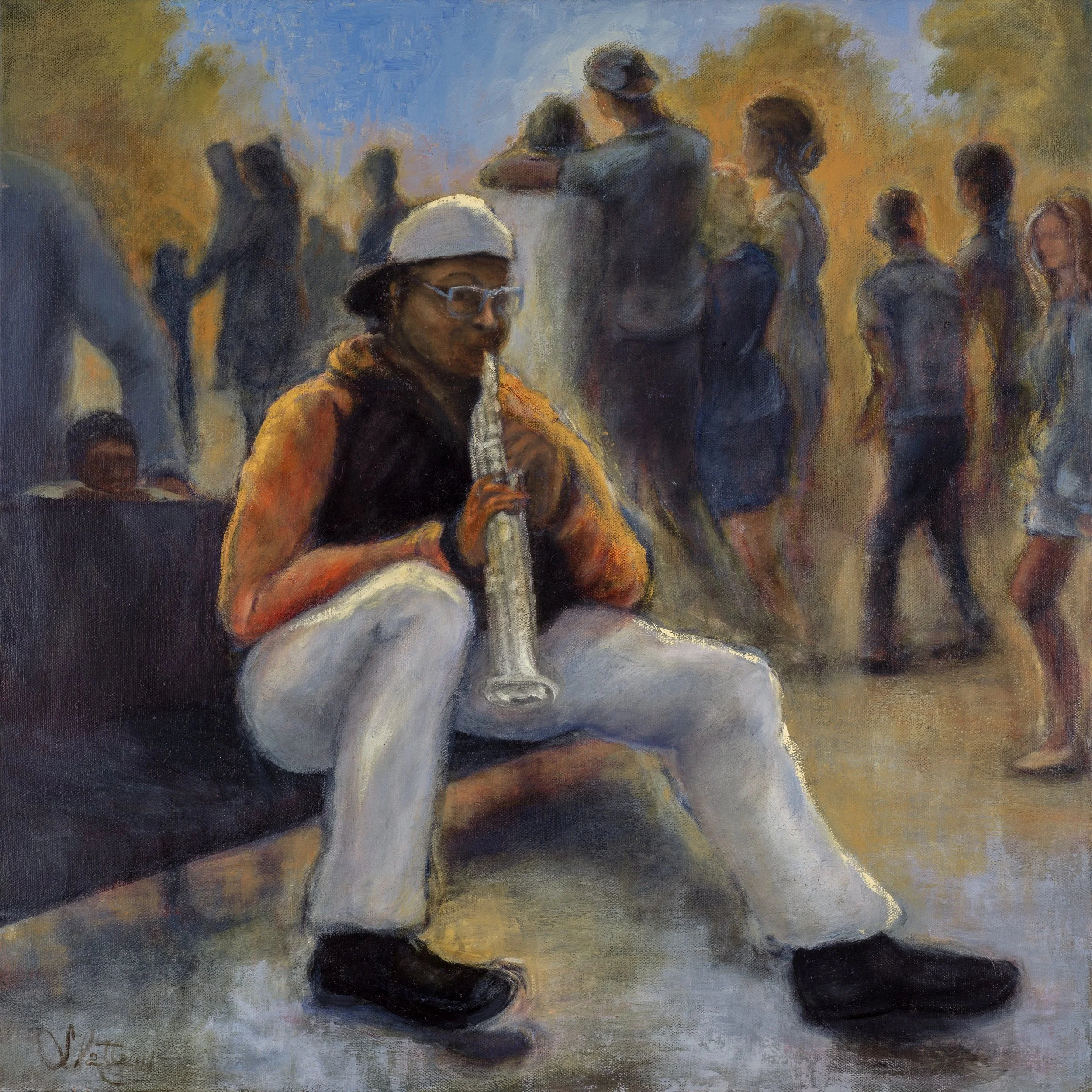
The original is oil on canvas, 20” x 20”.
At the center, on a weathered park bench, a man in a hoody and a backward baseball cap holds an alto saxophone; the instrument is both a tool and an extension of his self.
Most passersby are part of the scene’s periphery: they are compositional shapes—necessary counterweights, not anchors. Only a little boy stands as a focal echo of the musician’s intent. He is small against the expanse; his attention is complete and uncomplicated.
Behind the bench, just out of frame, the boy’s father is present but unseen suggested by the shadow that falls long and protective across the slab, by the faint bulk of a jacket edge and the impression in the boy’s posture that he isn’t entirely alone. The father’s omission from direct view allows the viewer to sense guardianship without interrupting the intimate exchange between saxophonist and child.
The musician’s notes seem to pull the square inward; music is the connective tissue that can briefly reorder a public place into a private moment. The lone attentive listener—a child—gives the performance its meaning. The unseen father’s presence reassures without intruding. In this downtown expanse, a simple melody becomes the architecture that holds them together.
The original is oil on canvas, 20” x 20”.
At the center, on a weathered park bench, a man in a hoody and a backward baseball cap holds an alto saxophone; the instrument is both a tool and an extension of his self.
Most passersby are part of the scene’s periphery: they are compositional shapes—necessary counterweights, not anchors. Only a little boy stands as a focal echo of the musician’s intent. He is small against the expanse; his attention is complete and uncomplicated.
Behind the bench, just out of frame, the boy’s father is present but unseen suggested by the shadow that falls long and protective across the slab, by the faint bulk of a jacket edge and the impression in the boy’s posture that he isn’t entirely alone. The father’s omission from direct view allows the viewer to sense guardianship without interrupting the intimate exchange between saxophonist and child.
The musician’s notes seem to pull the square inward; music is the connective tissue that can briefly reorder a public place into a private moment. The lone attentive listener—a child—gives the performance its meaning. The unseen father’s presence reassures without intruding. In this downtown expanse, a simple melody becomes the architecture that holds them together.